Quzhou in Zhejiang province has formulated China's first regulation focusing on the construction of a "carbon account" system, which was approved on Dec 23 and is set to take effect on May 1, 2026.
The "Quzhou Carbon Account Construction and Application Regulation" marks a significant step in integrating legal and digital innovations in China's carbon management.
The new regulation formalizes Quzhou's reform experience, establishing a comprehensive carbon account management framework and enhancing carbon data applications in budget management, green finance, and policy incentives.
As a national low-carbon pilot city, Quzhou faced challenges in balancing industrial growth with ecological protection. In response, the city pioneered a carbon account system covering seven areas: industry, agriculture, energy, construction, transportation, daily life, and forestry carbon-sink trading, making carbon emissions as manageable as bank deposits.
Over five years, Quzhou established more than 2.39 million carbon accounts, reducing carbon emissions by more than 4.5 million metric tons.
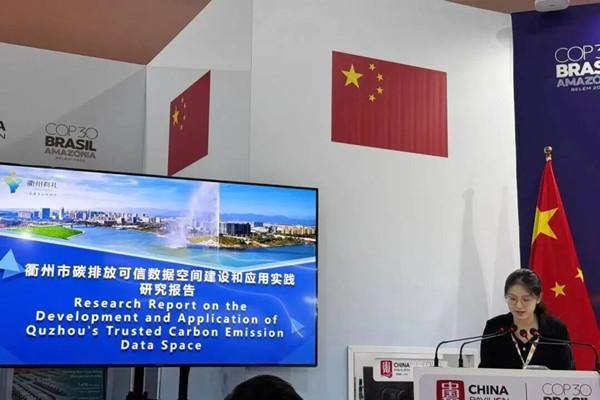
Quzhou's carbon account system is showcased during the COP30 UN climate conference. [Photo/Tide News]
Carbon accounts are transforming residents' lives and industrial development in Quzhou. Residents earn "carbon points" in their accounts through low-carbon actions, redeemable for benefits like bike-sharing vouchers. Companies use the carbon data to assess their products' carbon footprints, driving green growth.
Quzhou's carbon account system, recognized by national authorities and showcased during the 30th Conference of the Parties to the United Nations Framework Convention on Climate Change, offers valuable insights for global carbon management.
Liu Qiao, dean of the Guanghua School of Management at Peking University, noted its role in exploring institutional pathways for carbon control during a crucial stage of global climate governance.










 浙公网安备33010502011796号