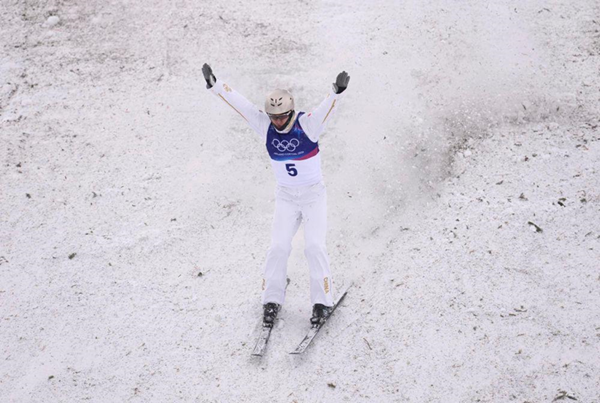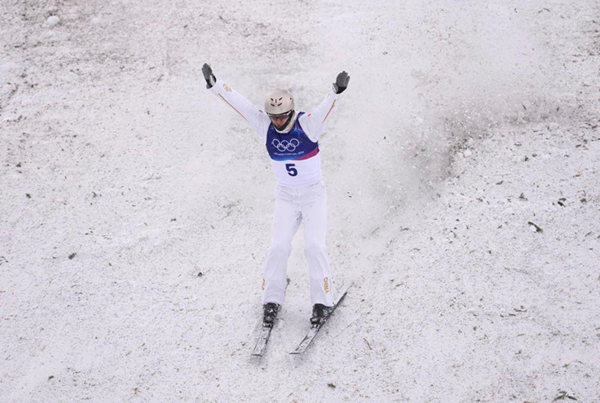
At the Milano-Cortina 2026 Winter Olympics, Chinese freestyle skier Wang Xindi clinched gold in the men's aerials event with a score of 132.60, executing a move with a 5.1 difficulty rating. His wife, China's freeski aerials star Xu Mengtao, also defended her title, winning the women's championship.
While the couple's dual victory captured headlines, it was the culmination of a four-year technological endeavor. Scientists from the Deqing Academy of Satellite Applications, located in Deqing county, Huzhou, Zhejiang province, developed a precise wind measurement system to transform complex wind conditions into real-time, visual data for athletes.
Traditionally, wind conditions were assessed using trackside flags and coaches' experience, lacking quantitative backing.
Before the 2022 Beijing Winter Olympics, Shao Yun, head of the Deqing Academy of Satellite Applications, led a team to the snowfields. Their mission: make the wind "visible". High-precision instruments were deployed around the track, detecting changes in wind speed and direction within a 10-meter range.
Collecting data was just the beginning. The challenge lay in converting these abstract numbers into practical guidance for athletes. Project leader Huang Fuxiang introduced the "wind index", a simplified algorithm that translates wind data into an intuitive value. This is transmitted to coaches for quick assessment of wind conditions, aiding decisions on whether to attempt high-difficulty moves or opt for safer jumps.
Initially a research project at the Beijing Olympics, this system became a staple in training by the Milan Games, turning wind data into quantifiable, analyzable experiences, enhancing athletes' intuitive responses.










 浙公网安备33010502011796号