A five-member delegation led by Edwin Gorataone Dikoloti, Botswana's minister of lands and agriculture, has visited Huzhou in East China's Zhejiang province to learn about its sericulture industry.
The delegation visited two sericulture operations in Shanlian and Hefu towns, Nanxun district. Members inspected facilities for the joint rearing of young silkworms and observed the careful rearing of late-autumn silkworms, smart farming operations, and the mechanized harvesting of hybrid mulberry leaves.
The two sides discussed industry planning, growth cycles, pest and disease control, standardized rearing, production efficiency, seed and seedling supplies, and cultivation techniques.
The Huzhou Academy of Agricultural Sciences also presented hybrid mulberry seeds to support local trials and future cultivation in Botswana.
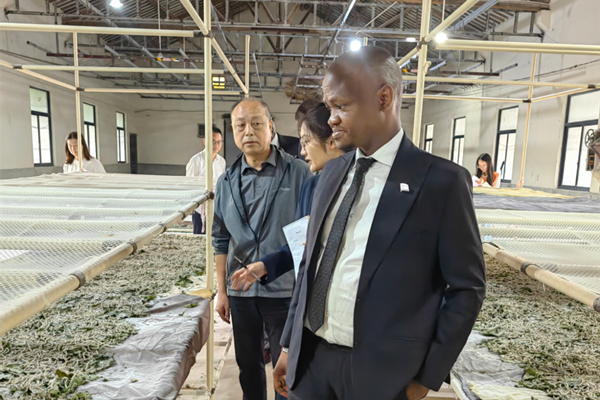
Edwin Gorataone Dikoloti, Botswana's minister of lands and agriculture (right), visits silkworm-rearing facilities in Huzhou, Zhejiang province. [Photo/Nantaihuhao App]
Dikoloti said Huzhou's modern sericulture practices and well-established industry could provide useful examples for Botswana. He said he hoped the visit would help establish regular agricultural exchanges and promote projects adapted to local conditions, creating opportunities to increase local incomes.
Huzhou has a long history in China's cocoon and silk industry, with heritage including the Mulberry-dyke and Fish-pond System, recognized as a Globally Important Agricultural Heritage System, the Qianshanyang archaeological site, and Jili silk.
In recent years, the city has worked to conserve and improve silkworm and mulberry germplasm resources, promote factory-based silkworm rearing using feed, and integrate agricultural machinery with cultivation techniques to extend the industry's value chain and improve economic returns.












 浙公网安备33010502011796号