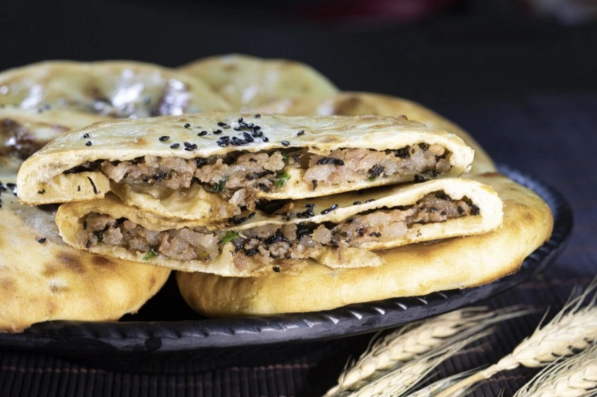
Jinyun shaobing. [Photo/Tide News]
In Jinyun county, Lishui, Zhejiang province, a small shop offering shaobing, a kind of bucket-baked roll, has served customers for over 30 years with just two tables and a traditional oven. Such longstanding eateries are common across the county, forming the roots of a local culinary tradition.
To elevate this hometown flavor into a renowned brand, the county government established a special administrative office in 2014, allocating 5 million yuan ($729,055.04) annually and standardizing baker training, trademarks, store operations, and production techniques.
As a result, direct employment in the industry has surged from 2,000 in 2013 to over 25,000 today, driving more than 50,000 jobs and training over 12,000 bakers. Their baking technique is now also recognized as a national intangible cultural heritage.
Jinyun shaobing has spread nationwide to scenic spots, universities, and highway service areas, and can even be found overseas, with a demonstration shop in Spain attracting customers from France, Australia, and Italy. Over 8,000 outlets currently operate across China, reaching 16 countries and regions.
While some preserve traditional methods, others embrace innovation. Xinfeng Food Company now runs four automated lines producing 200,000 shaobing daily, with 2025 sales exceeding 20 million yuan. Four local companies in Jinyun have adopted standardized production, transforming a manual craft into a thriving industry.
From roadside stalls to branded stores, Jinyun shaobing has captivated millions along the way to prosperity. In 2025, the entire industry chain's output reached 4.5 billion yuan, up 12.16 percent year-on-year.











 浙公网安备33010502011796号