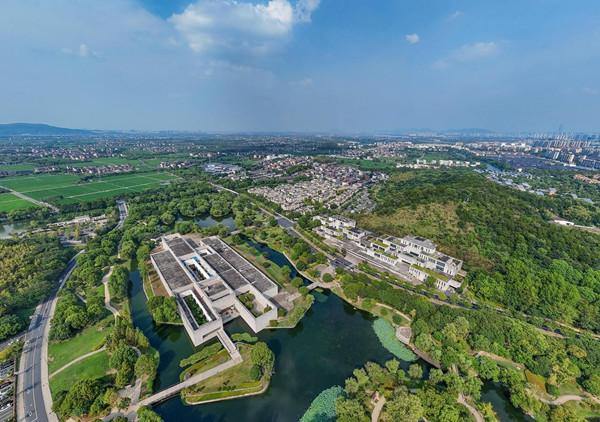
An aerial view of the Liangzhu Museum in Hangzhou, Zhejiang. [Photo/VCG]
As the fourth Liangzhu Forum approaches, the Liangzhu Cultural Corridor in Hangzhou, Zhejiang province, is offering a model for balancing heritage preservation with cultural industry development.
At a cultural exchange event in Beijing on Sept 24, experts from Zhejiang and Beijing discussed how the corridor has moved beyond protecting archaeological sites in isolation to integrating cultural resources with regional development.
Centered on the Liangzhu Ancient City Ruins, the corridor covers 634 square kilometers in northern Yuhang district and brings together 5,000-year-old Liangzhu culture, canal heritage, Jingshan culture, museums, and rural cultural venues, encompassing about 75 percent of Yuhang's cultural resources.
The corridor has also brought culture closer to everyday life. Since opening in July 2024, Liangzhu 5000+ Art Park has received more than 300,000 visits and signed 30 key culture-related projects. Other initiatives combine cultural innovation, rural tourism, educational programs, and immersive virtual reality experiences.
Long-term planning has supported this development. Since the corridor was proposed in late 2022, three rounds of 10 major projects have advanced its development from infrastructure building to quality improvement and industrial growth. The latest round, released in June, places greater emphasis on cultural industries and international outreach.
The initiative has also evolved from a district-level strategy into a provincial priority, reflecting Zhejiang's broader efforts to make cultural heritage a lasting part of contemporary life.







 浙公网安备33010502011796号