On March 21, an article and video entitled “Wenzhou and the Maritime Silk Road” was published on China Media Group’s Sino-Italian client, which revealed the long-standing historical stories between Wenzhou and Italy on the Maritime Silk Road. The protagonist of this article is Bonino Gabriella, an Italian female teacher at Wenzhou Business College who has lived in China for 32 years and speaks Mandarin fluently. Her Chinese name is Tang Yun.
After watching a wonderful Wushu performance at the annual meeting of Wushu Friendship Association in Wenzhou at noon on March 24th, Tang Yun said excitedly, “The performance was so brilliant, and I want to learn it.” She is almost obsessed with Wenzhou’s cultural treasures such as southern style boxing, Nanxi Opera, Oukiln and lacquer ware. With her growing understanding of Wenzhou’s culture, she jokingly said that she had transformed from a “China fan” to a“Wenzhou fan”.
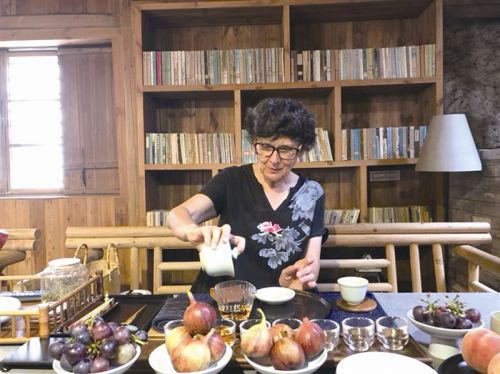
Tang Yun brews Chinese tea
Tang Yun begins her “China Dream” with the delicate Chinese cultural relics
Tang Yun was born in Turin, Italy. When she was 18 years old, she was attracted by the exquisite Chinese cultural relics after visiting the Paris Museum. From then on, she began her “China Dream”,aspiringto learn about the traditional Chinese culture. Her dream has lasted for 32 years since 1987 and will continue, since “I have been doing what I like in China. If conditions permit, I would like to stay here till I am 70 or 80 years old.”
Tang Yun chose to major in Chinese at university, and came to China to study Chinese alone in January 1987. After she graduated from Beijing Language College (now Beijing Language and Culture University) in Chinese major in 1989,she worked in the Italian Department of China Radio International forover26years until 2015, during which she hosted such radio programs as “Tea House in the Air” (formerly called “China in My Eyes”), and won the Chinese Press Column Award. In the meantime, she has published Sino-Italian bilingual works such as La Cinaaimieiocchi(China in my Eyes) and Allascopertadella Via della Seta: Dallecarovaneall’altavelocita (Discovering the Silk Road: From Camel Team to High-speed Rail), which earned her the nickname of“Contemporary Woman Marco Polo”.
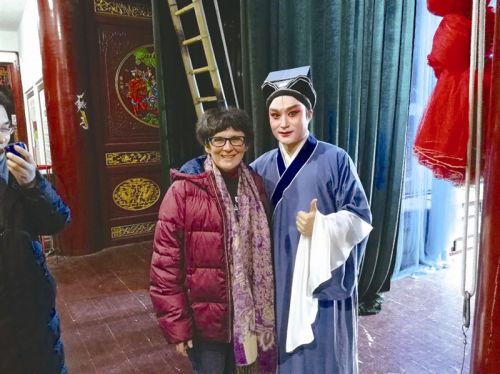
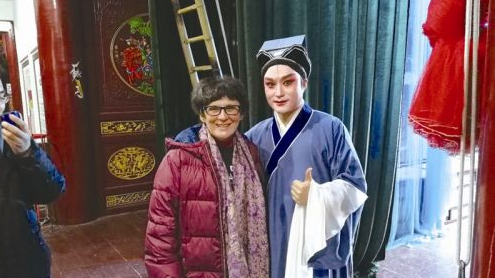
Tang Yun and Nanxi Opera Actor
Tang Yunwas attached to Wenzhou by luckduring the Spring Festival of 2002. Because of her love for local Chinese culture, she came to Wenzhou from Beijing alone to visit ancient villages along theNanxi River. At that time, she met her first Wenzhouese friend, Zhang Jincheng, now President of Wenzhou Ou Kiln Association. Later, as one of her friend from the northeast China came to teach art inWenzhou, Tang often came here as well to visit ancient villages along theNanxi River, Roofed Lounge Bridges in Taishun and other places of interest. Through her visits, she not only became fonder of those beautiful scenery and culture, but also edited and produced 16 radio programs about Wenzhou, introducing what she saw and heard in Wenzhou to Italian compatriots far away.
It was not until February 2017 that Tang Yun entered Wenzhou Business School and formally settled in Wenzhou, thus ushering in her journey ofOuyue culture.
Tang Yun’s research on “Wenzhou and the Maritime Silk Road” receives the attention of the state media
On March 21, when President Xi Jinping arrived in Italy for a state visit, a Sino-Italian bilingual article and video entitled “Wenzhou and the Maritime Silk Road” was published on China Media Group’s Sino-Italian client. In thisarticle, Tang Yun depicts a historical picture of the rise and fall of Wenzhou Port.
Located at the mouth of the Oujiang River, Wenzhou is a populous city with asmall land. It has always been famous for its commerce and trade, carrying out domestic and foreign trade. As early as the Warring States Period (475 B.C. - 221 B.C.), Wenzhou businessmen began to trade with Bashu (Now in Sichuan Province) and the State of Jin (Now in Shan Xi Province). By the Tang Dynasty (618- 907), it became an important port with a route from Wenzhou to Japan. At that time, Wenzhouese even set foot in Koryo (now Korean Peninsula), Siam (now Thailand) and Cochin (now Vietnam). By the Song Dynasty (960-1279), Wenzhou’s maritime trade reached its peak, with the government setting official shipyards and municipal shipping business in Wenzhou. According to records, Wenzhou’s tariff revenue reached approximately 1.2 billion yuan in 1150,equivalent to 5% of the national fiscal revenue at that time. By the Yuan Dynasty (1271-1368), it had become one of the seven major ports open to the outside world, exporting large quantities of tea, oranges, rice wine and various goods purchased domestically to Southeast Asian countries. By the Ming Dynasty (1368-1644), Wenzhou Port began to decline due to the continuous sabotages of Japanese aggressors along the southeastern coast and the ensuing imposition of sea ban by the court, but a recovery was seen in the early Qing Dynasty (1616-1912). After the signing ofthe Chefoo Convention in 1876, Wenzhou was opened as a trading port.
“During President Xi’s visit to Italy, my old colleaguesat China Radio International hoped to cover more Sino-Italian cultural stories. They knew that I had studied the Silk Road, so they called me for my contribution. I am in Wenzhou and I want to write about the city I like.” Tang Yun introduced that she had been studying the Desert Silk Road, but with the deepening of the study, she became all the more affectionate to the cultural and artistic beauty on the Silk Road. Therefore, she decided to continue studying the Maritime Silk Road in 2016and visited port cities like Nanjing, Hangzhou, Ningbo, and Wenzhou. Since 2017 when she came to Wenzhou, she became fascinated with Wenzhou because Wenzhou was a friendly cityin her eyes, making her feel at home. “In Italy, there are some Wenzhouese living in my neighborhood. When I was a child, I had dinner atWenzhouese restaurants. Now I come to Wenzhou. Everyone is very friendly to me. Even some strangers will talk to me about their relatives and friends in Italy after knowing that I am Italian. We feel very close to each other and are very friendly to each other.”
Tang Yun wants to become a window for compatriots to understand Wenzhou
“Because of the limited space of the article, I just tell a small part of my research results in this article. In fact, there are many more things I want to introduce about Wenzhou.” Tang Yun disclosed that she had a bigger goal: she wanted to create a “small encyclopedia” about Wenzhou for Italian readers, covering Wenzhou’s economic, cultural and artistic development, and outstanding figures, works and stories from ancient times to present.
Undoubtedly, the road of research is full of twists and turns. Tang Yun likes to fully understand Wenzhou’s culture by reading ancient books and documents related to Wenzhou. So far, she has read more than 100 books about Wenzhou. In addition, used to be a journalist, she prefers to go in person to visit the historical relics at close range, to appreciate cultural heritage such as Nanxi Opera, southern style boxing andOu Kiln, and to interview relevant cultural inheritors. So, when Wenzhou opera troupegoes to the countryside for performance, she will go along to follow up interviews; when there is a martial arts performance of southern style boxing, she willsurely be an audience; and she has evenvisited most streets and alleys of Wenzhou under the guidance of Yang Baomin’sThe Old Town of Wenzhouthat recorded the landscape of the old town of Wenzhou in the late twentieth century.
Tang Yunenjoyed her writing and research of Wenzhou. What bothers her is the accurate translation of technical terms. “There are a lot of difficult technical terms in Wenzhou’s Ou kilns and Nanxi operas. It’s really difficult to translate them into Italian accurately.” To crack this hard nut, Tang Yun often resorts to a variety of dictionaries, such as Chinese-English, Chinese-Italian, English-Italian dictionaries and so on.
“I hope to complete the first draft by the end of this year,” said Tang Yun. As an Italian in Wenzhou, she wanted to make herself a window for Italians to understand Wenzhou. “Although there are many Wenzhouese in Italy, the Italians do not know them well. When I was a child, I thought it hard to approach Wenzhouese since they always liked to speak Wenzhou dialect and were not good at Italian. Now their children have grown up, who are good at Italian and can better integrate into Italian culture. Pitifully, they know little about their hometown Wenzhou. So I want to write such a book which enables Italians to further learn about their neighbors–Wenzhouese. I hope that Italians can understand that Wenzhouese are not only businessmen, but also people from a place with prosperous culture and flourishing art; and I hope they can understand the historical origin of Wenzhouese traveling to Italy across the ocean.”




 浙公网安备33010502011796号