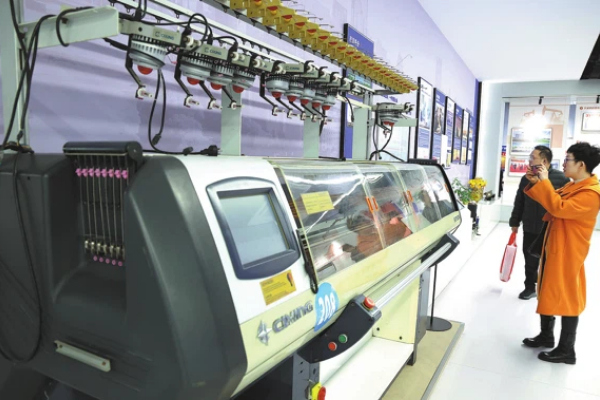
Visitors take photos of textile equipment at a private economy exhibition center on Dec 26, 2025, in Ningbo University of Finance and Economics in Zhejiang province. [Photo/The official news website of CHINA DAILY]
After the Wenling-Yuhuan section of the Hangzhou-Taizhou High-speed Railway, China's first high-speed railway with private capital in control, went into operation on Aug 8, Zhejiang province in East China made new progress in building its high-speed rail transport circle.
The newly opened section extends Zhejiang's high-speed rail network to the eastern coastal area of Taizhou city.
Data from China Railway Shanghai Group show that passenger volume on the Hangzhou-Taizhou High-speed Railway has exceeded 100 million since its opening in 2022, greatly aiding the flow of people, goods, capital and information along the route.
The Hangzhou-Taizhou High-speed Railway has formed a vital part of the Yangtze River Delta intercity railway network and become a model for Zhejiang to attract private capital into major transport projects, officials said.
Its Wenling-Yuhuan section adopts the public-private partnership model. Social investors led by China Railway Construction Investment Group funded the project together with the Wenling and Yuhuan local governments, while entrusting China Railway Shanghai Group with construction and operation.
Experts in development planning in Zhejiang noted that the Hangzhou-Taizhou High-speed Railway project breaks the traditional model under which railway projects were solely funded by State-owned capital with private capital holding minor shares. It enables effective alignment between government regulation and market-oriented operations.
Its operational model has become a reference case for industrial reform, exploring a replicable path for private capital to participate in railway investment, financing, construction and operation.
Sources from China State Railway Group noted that previous high-speed rail projects relied heavily on fiscal funds and capital of the national railway operators, resulting in heavy financial pressure and constrained expansion.
The practice of the Hangzhou-Taizhou High-speed Railway demonstrates that properly introducing social capital can ease the capital burden of railway infrastructure construction.
Meanwhile, the market-oriented mindset of private enterprises can drive innovation in passenger transport services and develop resources along railway lines, which is helpful to unlock the value of railway assets.
Zhejiang has been encouraging private enterprises to participate in major projects for a long time. Over decades of development, Zhejiang has witnessed magnificent growth of its private economy. Today, the private economy stands as one of the most dynamic engines powering high-quality development in the province.
Apart from the Hangzhou-Taizhou High-speed Railway, the Zhejiang San'ao nuclear power project located in Cangnan county, Wenzhou city — the first nuclear power project with private capital participation in China — officially entered commercial operation on April 29 and marks a landmark reform in China's energy investment and financing system.
In a bid to stimulate private investment, Zhejiang put forward the "three 70 percent targets" in 2023: no less than 70 percent of the provincial "4+1" special funds shall be channeled into private investment projects; no less than 70 percent of newly added and stock land resources shall support private investment projects; and no less than 70 percent of annually newly allocated energy consumption quotas shall go to private investment projects.
In 2025, Zhejiang set a goal to raise the targets to 80 percent. In 2026, the province formally launched the new targets.
In May, the Zhejiang provincial government released 13 measures centering on fostering a high-level innovation ecosystem and addressing the demands of private enterprises. The policy combines targeted support with reform and innovation, introducing measures with tangible benefits and a greater sense of gain for market entities.
Clauses 1 to 4 of the policy center on scientific and technological innovation, with plans to open up innovation resources including major scientific facilities, supercomputing centers and pilot-scale testing platforms.
Clauses 5 to 7 focus on opening up more sectors. They specify that nine sectors, including railways, nuclear power, offshore wind power and water supply will be opened to private capital. For-profit low-altitude economy projects, commercial aerospace projects and the like will be open to all market entities on an equal footing. Private enterprises will receive support in applying for commercial aerospace frequency licenses and launch approvals.
Clauses 8 to 10 target factor market reforms. Apart from the 80 percent targets, newly added industrial land and newly allocated energy consumption quotas shall back private investment. Each year, 666.7 hectares of land will be allocated to support small and medium-sized enterprises investing in projects with new quality productive forces.
Clauses 11 to 13 concern legal safeguards. The province will uniformly publicize bidding information across Zhejiang. Unreasonable access thresholds are strictly prohibited. Seizure and freezing of assets exceeding the amount involved in cases shall be rectified in accordance with laws and regulations.









 浙公网安备33010502011796号