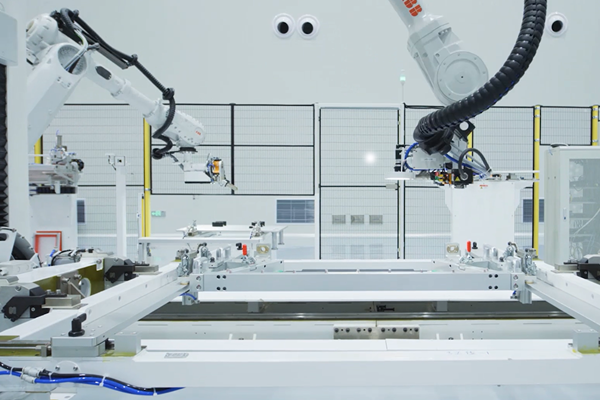
A satellite production line at Taizhou Geesatellite Technology in Taizhou, Zhejiang province. [Photo provided by Geesatellite]
Taizhou in East China's Zhejiang province is accelerating the growth of its commercial aerospace industry, with Taizhou Geesatellite Technology, a satellite manufacturer backed by Geespace, pioneering large-scale satellite production.
Established in 2019, the Taizhou-based company is the world's first satellite mass-production facility that integrates aerospace and automotive manufacturing capabilities. It is also home to China's first commercial satellite intelligent assembly, integration and test (AIT) center.
By combining aerospace technologies with intelligent manufacturing approaches, the company has developed a one-stop satellite manufacturing system and pioneered a new mass-production model for the commercial space industry.
The factory stands out with four key advantages: high output, fast delivery, high precision and lower costs. It can produce up to 500 satellites annually, with a daily output of one to two satellites, while supporting satellites ranging from ten kilograms to one metric ton.
"The production cycle has been shortened from one or two years to just 28 days," said Liu Yong, general manager of Geesatellite. "Automation and AI-based data management systems now support most of our production processes." The factory has also reduced satellite manufacturing costs by around 45 percent.
So far, Geesatellite has delivered 75 satellites, including those for its parent company's constellation project, major national programs and commercial clients. Among them, 72 satellites have successfully entered orbit, achieving 100 percent in-orbit reliability.
The satellite constellation operated by the Geesatellite's parent company has been expanding its international presence, having signed cooperation frameworks with more than 20 countries. "We are focusing on markets including the Belt and Road partner countries and regions such as the Middle East and South America," Liu said.
In recent years, Taizhou has accelerated the development of strategic emerging industries, including the low-altitude economy and commercial aerospace.
Leveraging Taizhou Bay New Area as a key platform, the city is fostering an integrated industrial ecosystem that connects commercial aerospace with low-altitude equipment, new energy vehicles, industrial machine tools and intelligent robots, creating new opportunities for air-space-ground applications and innovation.







 浙公网安备33010502011796号