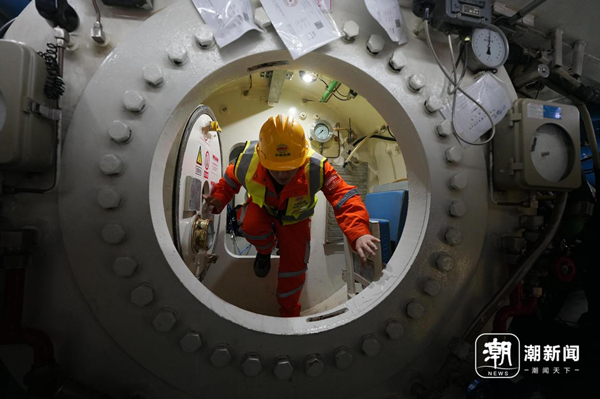
A worker exits the chamber after completing the debugging. [Photo/Tide News]
A domestically developed ultra-high-pressure life support system for shield tunneling, the first in the world to use a three-component mixed gas configuration, was put into operation on May 8 inside the Jintang subsea tunnel of the Ningbo–Zhoushan Railway at a depth of 69 meters below sea level in Zhoushan, East China's Zhejiang province.
The system was developed by China Railway 11th Bureau Group and is designed to support high-pressure maintenance operations inside shield tunneling machines under extreme subsea conditions. Workers enter a pressurized chamber and breathe a carefully mixed gas consisting of helium, nitrogen, and oxygen before the pressure is increased to about 7.6 bar within 3 to 5 minutes. They then move into an adjacent chamber filled with slurry to replace worn cutting tools.
According to project engineers, the current maintenance task in the Zhoushan section involves replacing 66 cutter tools on the shield machine as the tunnel approaches harder rock formations. The Jintang subsea tunnel is a key control project of the Ningbo–Zhoushan Railway and the world's longest undersea high-speed rail tunnel, with a total length of 16.18 kilometers.
The new system can support three workers in a single pressurized operation lasting up to 60 minutes, enabling up to 24 hours of continuous work through alternating shifts.
The system is expected to improve efficiency in deep-sea tunneling operations while providing a global reference model for similar high-pressure underwater engineering projects.







 浙公网安备33010502011796号