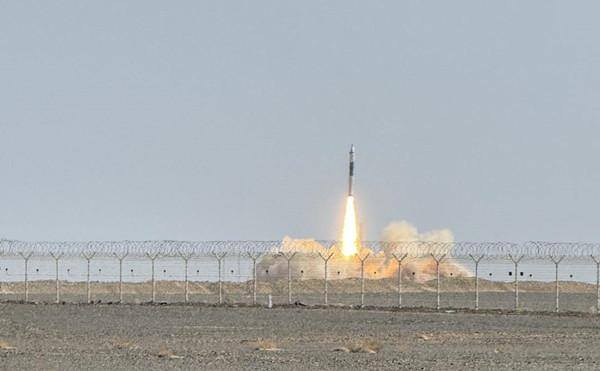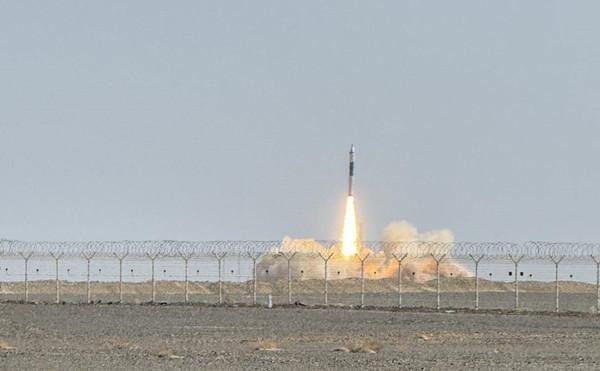
The Kuaizhou-11 Y7 carrier rocket blasts off from Jiuquan Satellite Launch Center. [Photo provided by Xu Jiayu for Tide News]
The Weitong-1 nanosatellite, developed and produced by Cosats in Jiaxing, East China's Zhejiang province, launched on the Kuaizhou-11 Y7 carrier rocket from the Jiuquan Satellite Launch Center on March 16, entering its designated orbit 500 kilometers above Earth.
Micro-nano satellites, typically weighing between 1 and 100 kilograms, offer lower costs, shorter development cycles, and simpler network coordination compared to traditional large satellites.
Weitong-1, weighing about 20 kg and roughly the size of a household rice cooker, is equipped with multispectral and infrared cameras that can capture detailed images of Earth, including temperature variations on the surface. It has a wide range of applications, including forest fire detection, urban heat island monitoring, and temperature change analysis in marine aquaculture.
Weitong-1 is the inaugural satellite of the Weitong Constellation, set to consist of 150 micro-nano satellites. This constellation will provide rapid, full-angle remote sensing data services for sectors such as natural resources, transportation, and environmental protection.
This launch also marks a key step for Cosats in transitioning from a satellite manufacturer to a big data operator. The company, one of China's pioneers in micro-nano satellite research, established operations in Jiaxing in 2024, with its products already exported to France, Brazil, and Egypt.












 浙公网安备33010502011796号