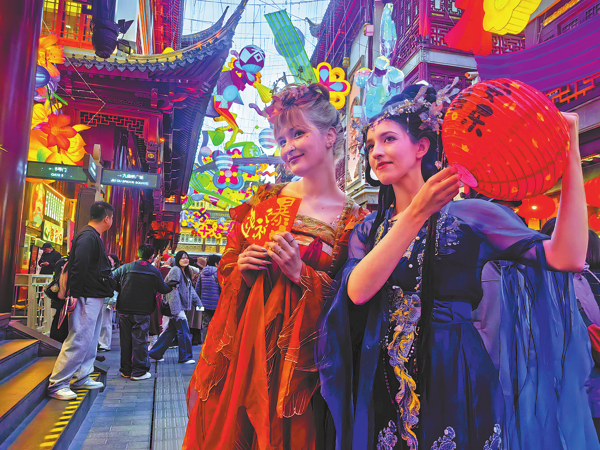
The recent social media trend of "becoming Chinese", or "Chinamaxxing" among Generation Z Westerners admiring Chinese culture and traditions, has had a spillover effect on the tourism market, as an increasing number of international travelers are visiting the Chinese mainland to experience the festive vibes of Spring Festival.
Spring Festival, or Chinese New Year, falls on Feb 17 this year, with a nine-day holiday starting on Feb 15. Long a cherished occasion for family reunions and celebrations across China, the festival has become a special opportunity for foreigners to experience traditional Chinese culture.
According to a recent report from travel portal Springtour.com, the number of inbound tourists expected to use the platform during the holiday had doubled year-on-year as of Jan 27.
Qunar, also an online travel agency, reported that flight bookings with non-Chinese passports bound for Chinese mainland destinations during the holiday have increased 30 percent year-on-year as of the end of January, with most travelers from South Korea, Vietnam, Singapore, Australia and Indonesia.
Growing numbers of foreign travelers are also arriving from Europe and South America, Qunar said, highlighting that the number of visitors from Argentina celebrating Spring Festival on the Chinese mainland has surged ninefold year-on-year.
Larger cities like Shanghai and Beijing remain the most popular destinations for overseas travelers, while lesser-known cities, such as Guilin in the Guangxi Zhuang autonomous region and Datong in Shanxi province, have also gained more popularity among the group.
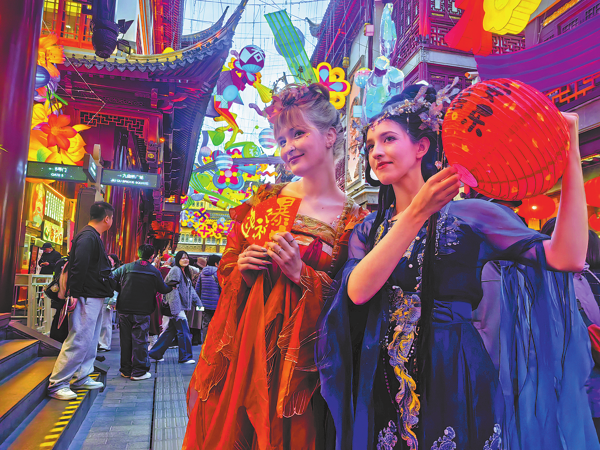
Tourists from Russia dressed in hanfu, or traditional Chinese attire, pose for photos at the Yuyuan Garden Lantern Festival on Thursday. The festival, which opened on Jan 26, has drawn a large number of foreign visitors with its rich traditional Chinese cultural elements. YANG JIANZHENG/FOR CHINA DAILY
Evan Kail, a visitor from the United States who has been touring the Chinese mainland since Jan 15, said he is deeply impressed by the vibrant Spring Festival celebrations.
Kail noted the cultural differences between the two countries, saying that holidays in the US are often shorter and more commercialized, whereas Spring Festival carries greater cultural depth and lasts longer.
"It (Spring Festival) is a whole season, not just a day. There's preparation, travel, family time, traditions, food and symbolism. It feels layered," said Kail, adding that the Chinese New Year's Eve dinner and putting up couplets were the highlights that impressed him the most.
"At first, I thought it was just decoration, but once you understand the meaning behind the words, the wishes for luck, peace and prosperity, it feels more personal. It's simple but meaningful, and I like traditions that carry that kind of weight," he added.
Arja Dutta, from India, said she has a strong interest in Chinese culture and has known about Spring Festival since 2019.
"I write Spring Festival couplets, and I feel touched when I write them," she said. "Spring Festival is the best time to experience the festive atmosphere. If you wish to experience the real and authentic Chinese culture, it will definitely be Spring Festival!"
Tourism insiders and experts have noted the global interest in experiencing Spring Festival in China, highlighting its significance in increasing the impact of Chinese culture worldwide and boosting confidence in traditional Chinese culture.
Zhang Jinshan, a researcher at Beijing Union University's tourism planning and development research institute, deems Spring Festival as a core symbol and significant carrier of traditional Chinese culture.
"In 2024, Spring Festival was officially inscribed on the Representative List of the Intangible Cultural Heritage of Humanity by UNESCO, enhancing its global recognition and evoking international travelers' desire to experience it personally," Zhang said.
"China's optimized policies on visas, payments and tax refunds have accelerated the recovery and growth of the inbound tourism market in recent years.
"As more foreigners come to China because of cultural fascination, it will greatly help the nation improve cultural influence, tell China's stories to the world, and enhance Chinese people's cultural confidence," he added.












 浙公网安备33010502011796号