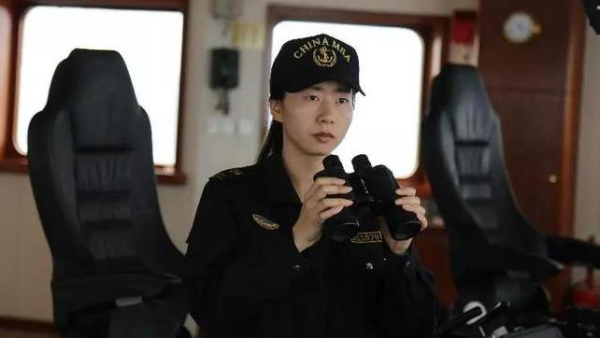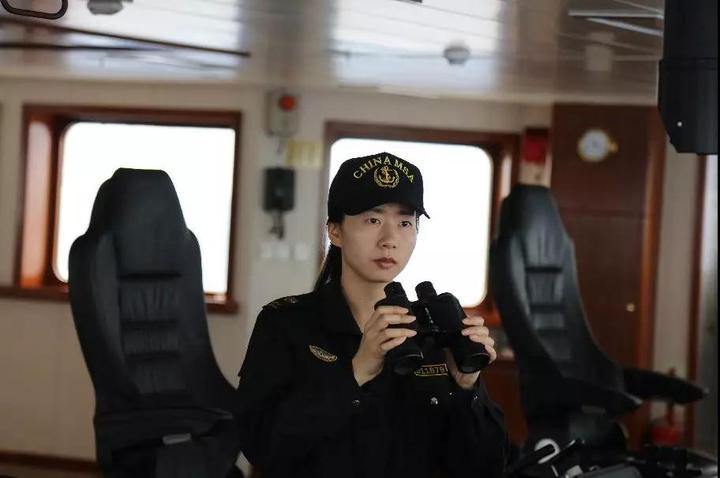
Zhan Chunpei is an intern chief mate on the “Coast Guard 01” vessel of the Shanghai Maritime Safety Administration East Sea Law Enforcement General Team. She is also the first helmswoman of non-restricted waters in the maritime system of China.
Zhan Chunpei is a native of Zhanxuwang Village in Zhejiang, whose parents are both farmers. Her younger sister has just finished the College Entrance Exam this year. Since her childhood, she has yearned for the sea, so she applied for the major of navigation technology of Shanghai Maritime University.
Zhan Chunpei said that on most naval vessels of China have female crew members but few helmswomen. Now that women can do other work in an oceangoing voyage, why can’t they take the helm? Therefore, she worked hard to study navigation technology and managed to obtain a third mate certificate during college.
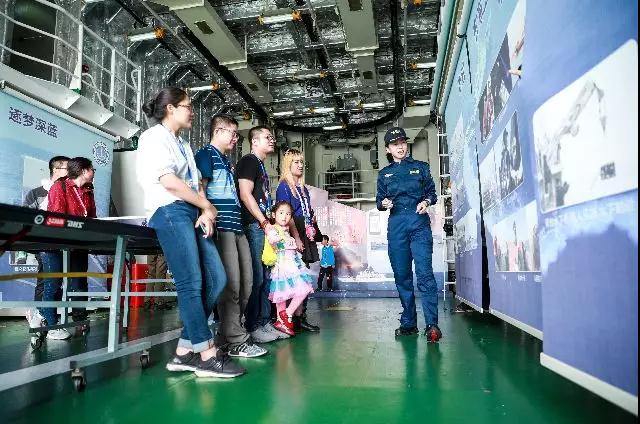
The problem she encountered in her first voyage was seasickness. “I vomited for nearly ten times on the first day,” Zhan Chunpei said.
The “Coast Guard 01” vessel is currently the largest, most advanced and comprehensively capable public service vessel and large-scale cruise rescue ship in China. In the past six years of maritime law enforcement search and rescue, Zhan Chunpei has participated in nearly twenty major maritime missions including the search and rescue of MH370, the construction of islands and reefs in the South China Sea, and the “Sanchi” Oil Tanker accident. She participated in almost every major search and rescue operations in the East China Sea area. Her voyage distance is already equal to four circles around the Earth.
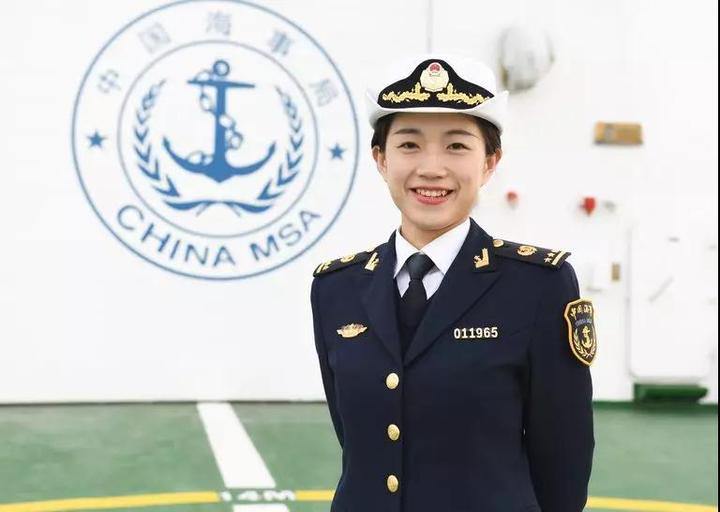
Beside Zhan Chunpei, on the “Coast Guard 01”, another girl named Yang Zhengni is also from Zhejiang. Yang is expected to be promoted to the second mate soon. Four years ago, she was admitted to the Shanghai Maritime Safety Administration and participated in multiple major missions. Meanwhile, she has also been the consecutive and simultaneous interpreter of several international maritime conferences.
Yang Zhengni was born in Jiyang Sub-district of Zhuji, Zhejiang. Having performed well in English, she thought that she would become a professional translator. She ultimately chose the major of sea navigation after her College Entrance Exam.
After joining the vessel crew, Yang realized that sea navigation itself is a globalizing work and English skills are necessary on many occasions. Therefore, she took the test of Senior Interpreter and the CATTI 2 translation test. She was selected as a consecutive interpreter for the East Asian Region Salvage Alliance Conference organized by the East Sea Rescue Bureau and she finished the task excellently.

Most seafarers are males because of the need for the job. They have to be away from home for a long time, work on a shift system and slightly closed living spaces, which are the main reasons why a lot of females are discouraged.
However, both Zhan and Yang said those who study sea navigation always dream of going deep into the blue sea and safeguarding the homeland. So do they, even if they are girls.
(Executive Editor: Xinyu Xie)








 浙公网安备33010502011796号