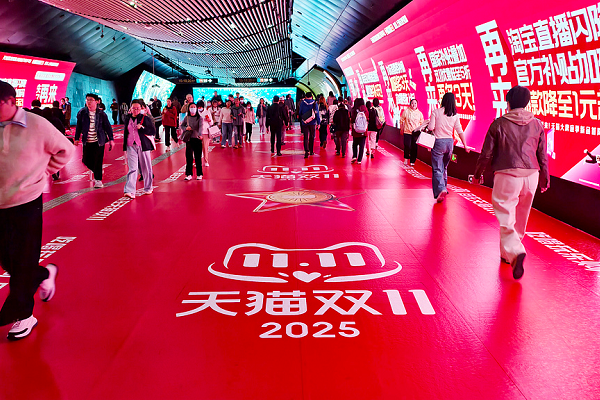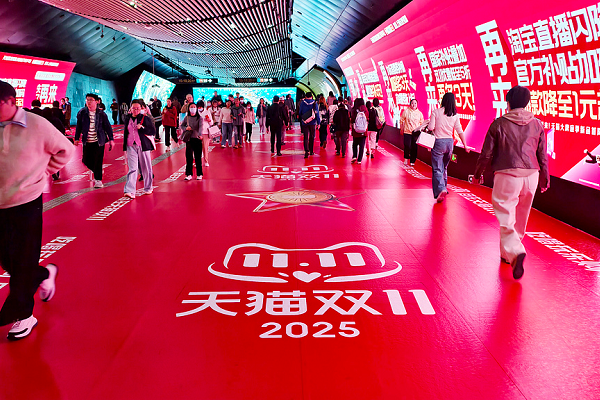
The Bund Sightseeing Tunnel in East China's Shanghai is filled with advertisements for Tmall and Taobao's Double 11 online shopping spree, Nov 11. [Photo/VCG]
With discounted sales of everything from AI-powered refrigerators to blind boxes, China's annual "Double 11" online shopping spree has highlighted consumption momentum that is moving toward smarter, greener and more emotionally resonant products.
A boost from policy and technology
China has released the fourth – and final – tranche of this year's 300 billion yuan (about $42.3 billion) in ultra-long special treasury bonds earmarked for trade-ins of consumer goods. The central government funding is part of a broader effort to revive domestic demand by upgrading industrial equipment and replacing old consumer goods such as home appliances and vehicles.
The Double 11 shopping spree lasts around a month each year and ends in mid-November. This year, Chinese e-commerce platforms have taken advantage of the country's trade-in programs to boost sales.
On Alibaba's Tmall, sales of consumer electronic products, including AI glasses and robots, have surged during the shopping spree, fueled by new product launches, AI features and sales promotions.
Tmall has reported that sales of smart glasses had jumped 25-fold year on year by Oct 30, and robotics brands such as DEEP Robotics and UBTECH Robotics have recorded double-digit growth.
On JD.com, sales of consumer electronic products with AI features have more than doubled year on year as of Tuesday. Smart glasses have seen the fastest growth at 346 percent, followed by 238 percent for digital cameras and 220 percent for action cameras.
Chinese consumers are increasingly buying quality products to meet their evolving demands, said Zhu Keli, founding dean of the China Institute of New Economy. "Tech products such as smart home systems and health-monitoring devices are becoming mainstream choices," Zhu said.
The rise of emotional spending
Beyond the allure of technology, this year's spree has revealed a new kind of consumer: one driven by emotion and self-expression. According to Tmall data, sales of gaming merchandise and blind boxes have more than doubled, fueled by younger shoppers seeking products that resonate with their identities.
"The emotional value of a product has a great impact on consumer decisions," said Yang Xiujie, e-commerce director of Shandong Yihao Customized Brand Management Co Ltd.
Yihao's "ugly-cute" cushion pillows and humorous office desk signs have become bestsellers. "These products have a unique appearance and humorous elements, and young consumers are buying them not just for function but for emotional comfort and identity," Yang said.
Experts say the shift also reflects demographic changes and cultural trends – from elderly consumers fueling the silver economy to Gen Z shoppers driving emotional consumption.
AI behind the screen
Apart from strong sales of products featuring AI, AI is also transforming the e-commerce sales process itself. Midea Group's livestreaming base in the central Chinese city of Wuhan uses AI visualization tools that allow shoppers to preview how appliances would fit into their homes, creating a near-realistic experience.
Tmall has leveraged AI to help hundreds of thousands of merchants boost marketing efficiency, including a system that matches discount coupons with potential buyers more precisely. The system covers a wide range of sectors – including fashion, beauty, electronics, home appliances, food, pet products and sports and outdoor equipment – and has improved consumer conversion rates.
Analysts believe China's policies to stimulate consumption are likely to be strengthened further as the world's second-largest economy seeks to expand domestic demand to boost its economy.
The Communist Party of China Central Committee's recommendations for formulating the 15th Five-Year Plan (2026-30) for China's economic and social development call for a notable increase in the GDP share of household consumption, and for strengthened inclusive policies that benefit consumers directly, among a series of measures to vigorously boost consumption.
Feng Lin from Golden Credit Rating believes that in addition to the recently released fourth batch of funding for China's trade-in programs, it is possible that more support funds will be earmarked to cover non-durable consumer goods in the fourth quarter, and more related consumption vouchers will be issued nationwide.










 浙公网安备33010502011796号