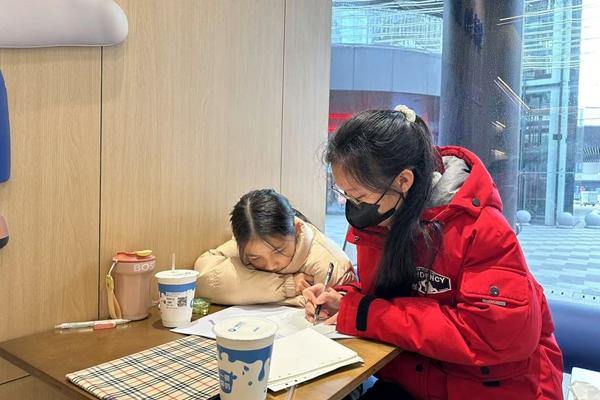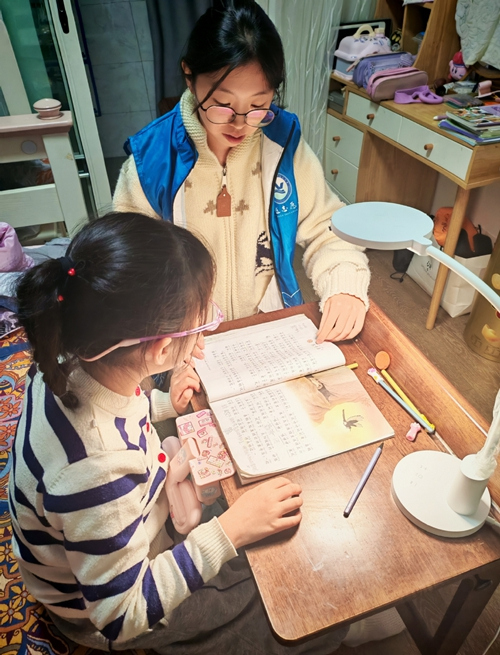
Wang Sihan (right) tutors an elementary school girl with language developmental delays through a volunteer program at Shaoxing University in Shaoxing, Zhejiang province. PROVIDED TO CHINA DAILY
Each September, as a new school year begins, students in blue vests gather in the canteen of Shaoxing University (USX) in Shaoxing, Zhejiang province. Standing behind recruitment tables, they invite freshmen to join a volunteer tutoring program that provides free academic support for children from disadvantaged families, particularly those with disabilities.
Eighteen-year-old Wang Sihan slowed down as she passed the booth. "This service is closely aligned with my major," said Wang, a freshman studying early childhood education. "I want to use what I'm learning to help children in need."
What she didn't know was that she was stepping into a tradition nearly three decades old.
"The tutoring program has been one of USX's signature volunteer initiatives since the university was founded," said Yang Yifan, director of the university's Youth League Committee office.
The program, Yang explained, was launched by the university's Youth Volunteer Association, driven by students' simple desire to "give back to society through knowledge".
The program officially partnered with the Gongde public service volunteer team — a group made up of retired officials — in 2007, and with the local disabled persons' federation in 2009, enabling the initiative to reach more people in need.
"Volunteers regularly visit local communities to assess needs," Yang said. "They identify families requiring support and learn about each child's situation. From there, we match volunteers with students."
So far, the project has mobilized nearly 1,500 volunteers and contributed a total of 27,000 service hours, assisting over 200 families affected by disability and tutoring more than 700 children.
Wang tutors an elementary school girl with language developmental delays. She noticed that although the girl struggles with reading, she is highly disciplined, often rereading passages repeatedly until she understands them.
"I've come to realize that every child is unique, with potential waiting to be discovered," Wang said.
Tian Xiangmei, 19, also found deep meaning in the experience. While many volunteers come from education-related majors, Tian is a clinical medicine student who was selected for her patience and strong communication skills.
"There's a principle in medical ethics that puts patients' well-being above everything else. I think that mindset applies to tutoring, too,"Tian said.
"Regardless of a child's abilities, as a future doctor — and as someone who teaches — I believe it's my responsibility to protect their health and their right to learn," she added.
Tian tutors a middle school girl who is being raised by her grandparents. The girl has cognitive difficulties and is learning at a first-grade level. To explain difficult concepts, Tian uses simple, visual strategies. When teaching math, for example, she found that the girl couldn't understand standard formulas, so she drew circles and counted them together to demonstrate addition and subtraction.
"Some of these strategies may seem basic," Tian said. "But if they work for my student, then they are the most effective ones."
Beyond tutoring, Tian also talks with the girl about school life and helps her navigate social challenges — such as making friends — which, Tian said, has brought them closer.
Tian's decision to volunteer was shaped by her own childhood. "I was also raised by my grandparents as a left-behind child," she said."Sometimes neighbors made hurtful comments, but there were always kind people who helped me through it."
The program offers more than just a chance to give back — it also provides volunteers with a meaningful path for personal growth.
Yang Xi, an 18-year-old freshman majoring in English education, brings what she learns in the classroom directly into her tutoring sessions. For one student, she designed personalized flashcards and incorporated the child's love of drawing to make vocabulary easier to remember.
"I also applied principles from behaviorist psychology, using positive reinforcement," she said."Whenever my student answers correctly, I make sure to praise him immediately and sincerely."
Every weekend, Yang Xi travels 11 kilometers between campus and her student's home, rain or shine. "I feel a real sense of achievement when I can put what I've learned into practice in real-life situations," she said."It has also made me realize just how challenging — and rewarding — it is to be a teacher."
Yu Lingfei, 21, is now in her third year. She has progressed from a regular volunteer to the head of the tutoring program. She still remembers her first session, when she spent a long time trying to figure out how to teach effectively.
After each session, Yu and other volunteers record their teaching methods and lesson content in a shared manual. These reflections not only help them track their progress but also provide valuable guidance for future volunteers.
"Now I have more methods at my disposal," Yu said. "My skills have improved through hands-on practice."
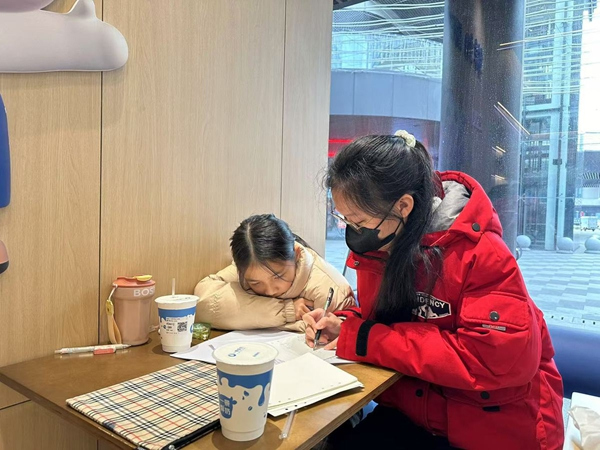
Yu Lingfei (right) tutors a child from a disadvantaged family through the program. PROVIDED TO CHINA DAILY
More than academics
As societal needs evolve, the role of the tutoring program continues to expand. "Today, families are not only concerned with academic performance but are increasingly focused on their children's emotional well-being as well," Yang Yifan said.
That shift is reflected in the program's training, which now places greater emphasis on mental health, alongside teaching skills and safety education.
"We hope volunteers can serve not just as teachers, but also as supportive friends, offering encouragement and helping children build self-confidence," Yang Yifan added.
Volunteers have also created a "heartfelt moments capsule", where they record reflections and meaningful experiences with their students. At the end of each semester, these notes are collected and turned into special gifts for the children.
"I can feel your dedication when you study and your confusion when you face challenges. I understand, because I've been there too," Yang Xi wrote in a note to her student — a boy who lives with his uncle because his father, who has an intellectual disability, is unable to care for him.
For Yang Xi, these notes are more than words of comfort. They are also a record of shared progress.
"Volunteering is a process of mutual growth," Yang Yifan said."Students step out of the comfort of university and into the lives of vulnerable families, gaining a deeper understanding of society."








 浙公网安备33010502011796号